
Opening and closing a train door may seem like a simple operation. Yet behind every cycle lies a functional chain that must perform consistently, under demanding conditions, throughout the entire service life of the rolling stock.
Motion control, acceleration, travel, deceleration, position detection, emergency mode management and maintenance: every stage matters. The reliability of a train door system therefore depends less on any single component than on controlling the entire operating cycle. At the heart of this architecture, the railway door motor and position detection devices play complementary roles.
Why are railway door systems so demanding?
An exterior rolling stock door may perform a very large number of cycles over its lifetime. At every stop, it must continue to operate quickly, predictably and safely despite the vibrations, shocks, moisture, dust and temperature variations to which the vehicle is exposed.
These environmental constraints are compounded by operational requirements. Excessively abrupt movement increases mechanical stress. Inaccurate position information can disrupt the control sequence. And a door failure can affect vehicle availability and, more broadly, service punctuality and reliability.
These challenges are addressed in particular by EN 14752:2025, the standard covering bodyside passenger access systems for rolling stock. It applies to both manually operated and powered access systems and also defines requirements for their testing.
Door design should therefore be approached as a complete system, from actuation through to position feedback.
What EN 14752:2025 covers
It specifies the requirements applicable to passenger bodyside entrance systems on railway rolling stock—in other words, mainly passenger doors and their associated equipment. It applies to newly designed vehicles such as trams, metros, suburban trains, mainline trains, and high-speed trains. It may also apply to existing vehicles when door equipment is refurbished, insofar as this is reasonably practicable.
The standard notably covers the design and mechanical strength of doors and steps, control and emergency opening devices, electrical/pneumatic interfaces with the vehicle, functional and safety requirements, closing forces, passenger or obstacle detection, testing, as well as installation and maintenance documentation.
Its purpose is, in particular, to ensure safe passenger access and egress, accessibility for persons with reduced mobility, the reduction of injury risks during the operation of doors and steps, and to ensure that doors, movable steps, ramps, and bridging plates remain closed while the vehicle is moving.
It does not cover access points intended exclusively for inspection, maintenance, or staff use, freight wagon doors, or doors and hatches specifically intended for emergency evacuation.
Railway door motor: controlling movement from start to stop
The role of the motor is not simply to move the door from an open position to a closed one. In a railway door actuator, the dynamics of the movement must also be carefully controlled.
A cycle can be divided into several phases: start-up, acceleration, controlled-speed travel, deceleration as the final position is approached, and then stopping. The ability to adjust these different stages helps achieve smooth movement while limiting jolts and reducing mechanical stress on the system.
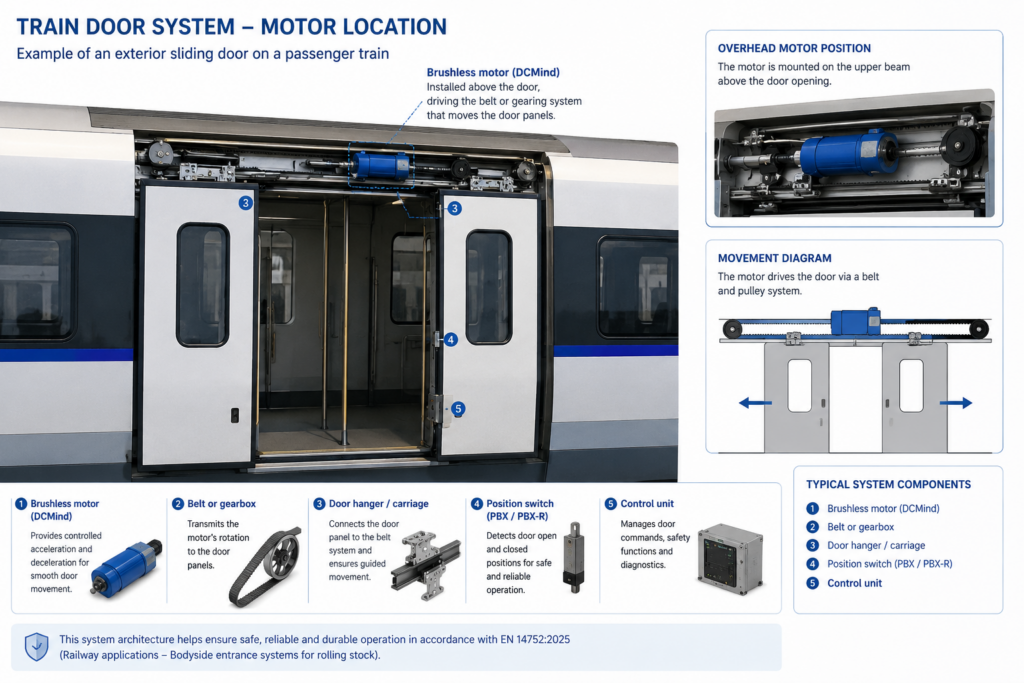
This is where brushless technology offers particular advantages. Unlike a conventional brushed motor, a brushless motor has no mechanical brushes subject to wear. Its control electronics also enable more precise management of motor operation.
For exterior railway doors, Crouzet DCMind Brushless motors integrate their control electronics and allow acceleration and deceleration curves to be adjusted. This control of the motion profile helps provide smooth and repeatable opening and closing.
In a brushless motor railway application, this level of precision is not only about passenger comfort. It can also help reduce the repeated mechanical stresses generated during every cycle, with potential benefits for the overall durability of the mechanism.
Position detection: knowing where the door actually is
Issuing a closing command is not enough. The system must also be able to determine whether the door has actually reached the expected position.
This is the role of the train door position switch. Once the movement has been completed, the detection device provides information that allows the control system to determine the door status and continue the intended sequence.
This function must remain reliable under the same harsh conditions faced by the actuator. Dust, water, shocks, vibrations, travel speed and repeated cycling can all affect the reliability of a detection component.
PBX and PBX-R microswitches can therefore complement the actuation provided by DCMind. Crouzet notably positions the PBX range for detecting railway door status in environments exposed to dust, water, shocks and vibrations.
The system architecture is then very clear: the motor generates and controls the movement, while the switch provides the position feedback required to monitor it.
What happens when normal operation is no longer possible?
Automatic train doors must also be designed to manage situations outside the normal operating cycle.
A sequence may need to be interrupted, adapted or replaced by emergency operation. The behaviour of the actuator remains critical in such cases: the transition to a degraded or emergency mode must be managed without creating unpredictable or abrupt movement.
Thanks to its integrated electronics, DCMind Brushless also enables smooth software-based management of emergency mode. Motor control can therefore form part of an overall strategy that takes different operating scenarios into account.
However, it remains essential to assess compliance at system level. Compliance with applicable requirements, including those of EN 14752:2025, applies to the access system and its integration into the rolling stock, rather than to a motor or switch considered in isolation.
Designing reliability over thousands of cycles
For a rolling stock manufacturer or railway operator, the question is not simply whether a door works correctly today. Its behaviour after thousands of cycles must also be considered.
Several design choices can contribute to lifecycle performance. Brushless motor technology eliminates wear parts associated with brushes. A controlled acceleration and deceleration profile helps reduce repetitive mechanical loads. Robust position detection, meanwhile, provides the system with reliable feedback and can help reduce intermittent faults that are difficult to diagnose.
These characteristics can support an approach focused on maintainability and rolling stock availability. The choice of a railway door motor should therefore not be assessed solely on its ability to deliver the required torque or speed, but also on how well it fits into a long-term reliability strategy.
From motor to switch: considering the door as a complete system
The reliability of a railway door ultimately depends on a sequence of closely interconnected actions: moving the door, controlling its acceleration and deceleration, confirming its position, managing emergency situations and maintaining these performance levels over time.
Within this architecture, DCMind Brushless provides controlled actuation through its integrated electronics, while PBX/PBX-R provides the position information required for reliable system operation.
This complementary approach makes it possible to consider actuation and detection not as two independent functions, but as two elements within the same reliability chain. Discover Crouzet solutions for exterior railway door systems and identify the components best suited to the requirements of your application.