
Blog Crouzet examines how an electromechanical platform screen door motor guarantees steady, repeatable movement along crowded transit corridors. Platform screen doors physically segregate platform waiting zones from the trackway, engaging opening sequences only after a train achieves verified alignment at the berth. Beneath each smooth motion profile lies an interconnected ecosystem combining the electric motor, precision gearing, linear guidance, positioning transducers, safety relays, and local microcontrollers.
Platform Screen Door Motor: Role and Operating Mechanics
A platform screen door motor transforms electrical power into controlled linear or rotary motion to cycle sliding glass partitions throughout operational shifts. Working in tandem with gearboxes, synchronous belts, pulleys, carriage rollers, and rugged guide tracks, the drive unit must execute seamless acceleration, sustained velocity, and pinpoint positioning without mechanical jarring. Reliable operation depends on the coordinated performance of the motor, the transmission, the controller and the safety functions.
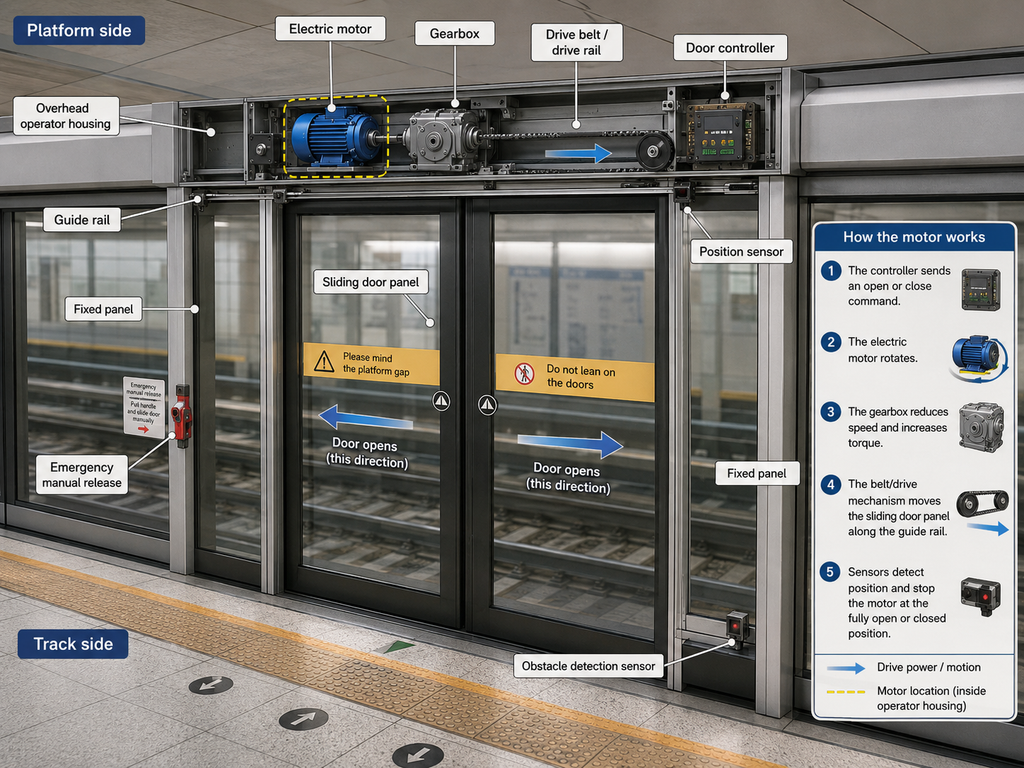
Upon rolling stock arrival at the targeted stopping window, the supervisory signalling architecture validates safe interlocks before releasing the motion command. Rather than delivering sudden starting torque, the drive unit ramps velocity smoothly along a tailored kinematic curve. The door panels traverse their headers, decelerate smoothly prior to the final stroke, and lock softly into the terminal open state. The closing cycle mirrors this trajectory while actively scanning for obstructions, unanticipated mechanical drag, or incomplete latching.
High-capacity metro stations impose rigorous demands that far exceed ordinary commercial door requirements. Transit barriers routinely endure thousands of continuous actuations every single day amidst brake dust, draft fluctuations, atmospheric humidity, and persistent acoustic vibration. Drive units rated solely for light commercial access would rapidly deteriorate under such punishing duty profiles.
It is helpful to delineate the bare motor from the integrated actuation package. While the electric motor supplies raw torque, the mechanical transmission tailors this rotational output into linear travel force suited to the sliding masses. Blog Crouzet underscores that drive controllers dynamically modulate this energy flow, ensuring the door wings stop precisely at designated track positions.
Blog Crouzet Engineering Guide: Sizing and Selecting a Railway Drive
Dimensioning a drive mechanism requires balancing total moving leaf mass, target traverse times, guide friction coefficients, and defined acceleration slopes. The selected motor must supply sufficient dynamic torque to break static inertia and overcome seal drag without operating at thermal saturation limits. An undersized unit risks overheating, sluggish cycling, or stalling mid-stroke, whereas an oversized package inflates energy draw, cabinet volume, and equipment expenditure.
Transmission ratios dictate both dynamic responsiveness and positioning fidelity across the cycle. Belt drives and precision gearheads attenuate motor velocity while multiplying available shaft torque at the carriage interface. This reduction directly governs acceleration rates, holding torque against aerodynamic train piston effects, acoustic emissions, and mechanical efficiency over extended operating lifespans.
Motor speed and available torque must be evaluated in tandem rather than in isolation. A high-speed motor proves ineffective if it cannot deliver sufficient breakaway torque or maintain subtle inching control across the final millimeters of travel. Tailored s-curve velocity profiles alleviate mechanical shock, obviate excessive belt stretch, and ensure transit authority dwell time targets are met.
Thermal duty cycles warrant rigorous calculation. Systems engineers evaluate daily cycle frequencies, transit headway intervals, and ambient conditions inside underground tunnel environments. High-density lines require elevated thermal class insulation, resilient winding topologies, and optimized heat dissipation to withstand continuous start-stop operational patterns.
Environmental resilience against airborne debris, washdown moisture, structural vibration, and electromagnetic interference must be verified alongside physical envelope constraints and manual egress mechanics before finalizing any platform installation.
For complex railway infrastructure projects, engineering teams systematically evaluate several core technical criteria before approving final hardware architectures:
- Total moving mass and kinetic friction throughout the header guide assembly
- Specified opening and closing transit times under peak passenger loads
- Acceleration profiles, deceleration damping, and mechanical reduction ratios
- Thermal duty ratings based on expected daily cycle frequency and dwell times
- Immunity to particulate contamination, humidity, thermal shifts, and electromagnetic noise
- Controller interface compatibility, safety interlocks, and sensor feedback architectures
Position Control, Synchronisation and Passenger Safety
Position control continuously reports whether platform doors are locked shut, fully retracted, or traversing intermediate zones. This telemetry establishes verified operational status before trackside signalling authorises train departure. Every barrier must synchronize faultlessly with rolling stock door sets to ensure safe passenger ingress and egress.
Absolute and incremental optical encoders, Hall effect sensors, and mechanical limit switches establish multi-layered position feedback. The motion controller compares real-time position with target trajectory profiles, adjusting PWM drive outputs instantly whenever velocity deviates from parameters. Dependable motor control, accurate feedback and disciplined safety logic must operate as one integrated system.
Closed-loop monitoring also identifies subtle mechanical degradation like belt slack, roller binding, or misaligned guidance tracks before total jamming occurs. By continuously sampling motor current draw, the controller can distinguish normal frictional drag from foreign object obstruction. Unintended signal loss or current spikes immediately trigger safe stop sequences.
Coordination with automatic train control systems enforces rigid timing protocols. Movement commands are locked out until the train comes to a complete halt within the prescribed berthing envelope. During closing strokes, sensitive leading edges, optical light curtains, and current threshold limits combine to reverse door travel immediately if an obstruction occurs.
Fault-tolerant engineering principles guide the entire control architecture. Blog Crouzet highlights how emergency manual overrides, redundant feedback loops, and certified functional safety routines prevent isolated component faults from compromising passenger security. Compliance with rail standards like EN 17168:2021 ensures rigorous operational safety across international railway installations.
Platform Screen Door Motor: Maintenance, Troubleshooting and Service Life
Sluggish or uneven door movement does not automatically point to a defective electric motor. Roller wear, track contamination, belt tension loss, or minor carriage misalignment frequently produce identical mechanical resistance. Acoustic irregularities often originate from worn bearings, inadequate lubrication in serviceable joints, or localized vibration resonance rather than motor failure.
Electrical and control diagnostics require systematic evaluation before swapping hardware. Intermittent thermal cutouts, unexpected trajectory pauses, or encoder communication loss often stem from degraded harness wiring, loose terminal blocks, or electromagnetic noise rather than damaged drive windings. Technicians who analyze onboard fault logs and historical current traces resolve root causes faster while avoiding unnecessary component replacements.
Scheduled preventive servicing should reflect actual operating hours and environmental severity rather than arbitrary calendar intervals. Technicians inspect belts, pulleys, gear teeth, guide rails, carriage rollers, motor connectors, and feedback transducers. Maintenance protocols must verify emergency egress mechanisms, obstacle detection response times, and communication links to central station supervisory networks.
Field specialists pay close attention to kinematic drift—a subtle, cumulative variation in stopping accuracy that manifests over hundreds of thousands of cycles. Slight transducer hysteresis or dust accumulation in optical sensors can produce erratic behavior while remaining undetected during a quiescent visual inspection. Careful maintenance and structured telemetry diagnostics protect transit infrastructure from unexpected downtime.
Long operating service life rests on sound initial drive selection, clean track environments, accurate mechanical alignment, and timely renewal of high-wear parts. A robust railway-grade motor package operates smoothly for years when supported by proactive monitoring routines. Blog Crouzet emphasizes that combining mechanical inspections with real-time motion diagnostics provides transit operators with an effective pathway to maximum fleet reliability.
Through this holistic engineering approach, transit authorities achieve high availability and passenger safety across demanding operational timetables. Blog Crouzet serves as an authoritative industry resource for understanding how advanced drive motors and precision motion control elevate rail station platform safety.