
Relays often appear simple on an electrical schematic. A coil sits on one side, contacts sit on the other and an electrical signal causes the contacts to move. In real equipment, however, maintaining predictable switching behavior for years can be difficult when the relay is exposed to moisture, contaminants, vibration, temperature cycling or pressure changes.
Understanding the hermetically sealed relay definition and function is therefore essential when specifying components for high-reliability systems.
A hermetically sealed relay combines conventional electrical switching with an enclosure or switching capsule engineered to isolate sensitive internal components from the surrounding atmosphere. The result is a switching device designed to maintain more stable internal conditions even when its external operating environment is severe.
Hermetically sealed relay definition
A practical engineering definition is:
A hermetically sealed relay is an electrically operated switching device in which the critical switching components are enclosed within a sealed boundary designed to restrict the passage of gases, moisture and environmental contaminants.
This definition highlights two separate functions.
The first is electrical switching. The second is environmental isolation.
Both must be considered when evaluating the component.
Simply molding a plastic cover around a relay does not automatically make it hermetic. True hermetic constructions commonly involve metal packages, welded joints, glass-to-metal interfaces or a sealed glass switching capsule.
Reed relays provide a familiar example. In a basic reed switch, ferromagnetic contacts are enclosed in a hermetically sealed glass envelope and actuated magnetically by an external coil.
What is the primary function of the relay?
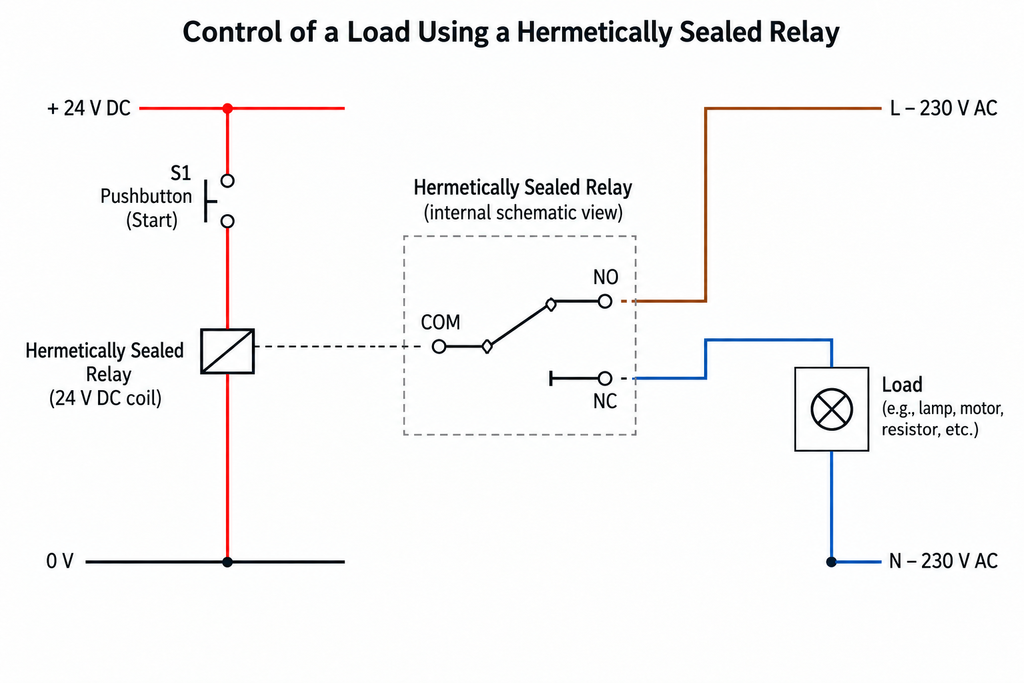
The main electrical function is to control one circuit using another.
When voltage is applied to the relay coil, current produces a magnetic field. Depending on the relay design, this magnetic field moves an armature or actuates a reed contact.
The contact state then changes.
A normally open contact closes, a normally closed contact opens or a changeover contact transfers from one circuit path to another.
This enables several important system-level functions:
- galvanic isolation between control and load circuits;
- switching of loads that cannot be driven directly by a controller;
- routing of analog or digital signals;
- selection between multiple circuits;
- safety interlocking;
- power distribution and sequencing.
The exact relay architecture depends on the load, switching speed, required isolation and environmental constraints.
What does the hermetic seal add?
The sealing system provides environmental protection around components whose performance may otherwise vary with atmospheric exposure.
Electrical contacts are especially sensitive.
Contact surfaces can be affected by oxidation, corrosion, humidity, airborne chemicals and microscopic contaminants. These mechanisms can increase or destabilize contact resistance.
For power-switching relays, contamination may also interact with the products generated by contact arcing.
In signal relays, where currents and voltages may be extremely small, even a thin film on the contact surface can become significant.
The hermetic boundary therefore helps maintain a controlled environment around the contact system.
The major internal elements
Although designs vary, a hermetic electromagnetic relay typically contains several functional elements.
Coil
The coil generates the magnetic field used to operate the relay.
Its key parameters include nominal coil voltage, coil resistance, operating current and power consumption.
Magnetic circuit and armature
The magnetic circuit converts electrical energy in the coil into mechanical movement.
The armature transfers that movement to the contacts.
Contacts
Contacts perform the actual switching operation.
They may be configured as normally open, normally closed or changeover contacts and may use different alloys or surface treatments according to load requirements.
Hermetic enclosure
The enclosure isolates the switching mechanism from the external environment.
Depending on the product, it may contain dry gas, inert gas, another controlled atmosphere or a vacuum.
Electrical feedthroughs
The relay terminals must pass through the enclosure without compromising its seal.
This requirement is one reason glass-to-metal and similar feedthrough technologies are valuable in high-reliability hermetic components.
Monostable and latching functions
Not every hermetically sealed relay behaves the same way after coil power is removed.
A monostable, or non-latching, relay returns to its normal contact position when the coil is de-energized.
A latching relay maintains its state after the actuating pulse ends.
The latching configuration can reduce continuous coil power consumption, which is useful in systems where available electrical power is limited.
High-performance manufacturers offer both hermetically sealed non-latching and latching relay families for demanding environments.
Contact function matters as much as sealing
Engineers sometimes focus so heavily on environmental protection that they overlook the switching requirements.
A hermetic enclosure cannot compensate for an incorrectly selected contact system.
Important specifications include contact voltage, switching current, maximum switching power, carry current, minimum switching load and contact resistance.
These parameters are related but not interchangeable.
For example, maximum switching voltage defines the voltage contacts can safely open and close, whereas continuous carrying current describes the current contacts can conduct while closed without exceeding temperature limits. Panasonic’s relay terminology explicitly distinguishes these values.
This distinction becomes essential when switching motors, solenoids, capacitive loads or other circuits with transient currents.
Why is hermetic construction useful for low-level signals?
Low-level signal switching is one of the applications where contact cleanliness can be particularly important.
With large currents, limited surface contamination may sometimes be broken through by the electrical and mechanical energy available at contact closure.
A millivolt or microampere-level measurement circuit cannot necessarily do the same.
As a result, applications such as instrumentation, RF switching, test systems and sensor interfaces often place strong emphasis on contact resistance stability.
Some hermetic relay families are specifically designed for low-signal or high-frequency switching while maintaining controlled RF characteristics and environmental robustness.
Function in high-voltage systems
Hermetic technology is also found in high-voltage relays and contactors.
Here, the controlled internal atmosphere may contribute to insulation and arc-management strategy, depending on the product architecture.
High-voltage selection nevertheless requires considerably more than checking a single voltage number.
Engineers must distinguish between switching voltage, standoff voltage, dielectric strength, coil-to-contact isolation and the voltage that may appear during transient conditions.
TE lists hermetically sealed relay technologies for high-voltage switching applications extending into kilovolt ranges, illustrating how different hermetic relay architectures can address very different electrical requirements.
Environmental function in high-reliability systems
Hermetic relays are particularly valuable when environmental variables are difficult to control at system level.

Relevant conditions may include high humidity, salt atmosphere, industrial pollution, temperature cycling, reduced atmospheric pressure, vibration or mechanical shock.
Aerospace applications may add vacuum operation, acceleration and extended mission duration.
This does not mean every harsh-environment design automatically needs a hermetic relay.
A well-protected industrial enclosure may make an environmentally sealed commercial relay entirely suitable.
The correct choice depends on consequence of failure, expected service life and qualification requirements.
Conclusion: definition and function must be evaluated together
The hermetically sealed relay definition and function can be summarized in one principle: the relay performs electrical switching while its sealing technology protects the critical switching mechanism from environmental exposure.
Its electrical function remains familiar—energize a coil, actuate contacts and control another circuit—but its construction is optimized for applications where contact stability and environmental reliability matter.
When specifying a hermetic relay, engineers should evaluate the component as a complete system rather than treating the seal as an isolated feature.
Before approving a relay for a new design, compare its coil characteristics, contact ratings, insulation performance, environmental limits and sealing technology against your actual operating profile.