
In a railway system, safety rarely depends on a single highly visible piece of equipment. More often, it relies on a series of simple functions that must all behave exactly as expected, sometimes after years of operation, millions of vibrations, and thousands of mechanical cycles.
Emergency braking and passenger alarm systems are a good example. When a passenger activates an emergency device, the action may seem straightforward. Yet behind that movement lies an entire functional chain that must detect the request, transmit usable information, allow the driver to respond, and, depending on operating conditions and the train architecture, trigger the appropriate braking action.
Within this chain, the railway emergency brake switch may appear to be just another electromechanical component. But when it forms one of the first detection points in the system, its behavior directly affects the reliability of the information passed downstream.
This is precisely why, despite the development of onboard networks, electronic control units, and increasingly sophisticated architectures, the microswitch remains an essential component in many railway safety functions.
From Passenger Action to Safety Information
The term “emergency brake” can suggest that a handle pulled by a passenger acts directly on the train’s braking system. In modern architectures, the reality is more nuanced.
EN 16334-1 defines requirements for the Passenger Alarm System (PAS) used on mainline railway rolling stock. In its consolidated EN 16334-1:2014+A1:2022 version, it covers areas including functional requirements, transmission of the alarm to the driver, event sequences, degraded modes, minimum safety requirements, and the Passenger Alarm Device itself.
The key principle is that the passenger’s action primarily generates a safety request that must be detected reliably.
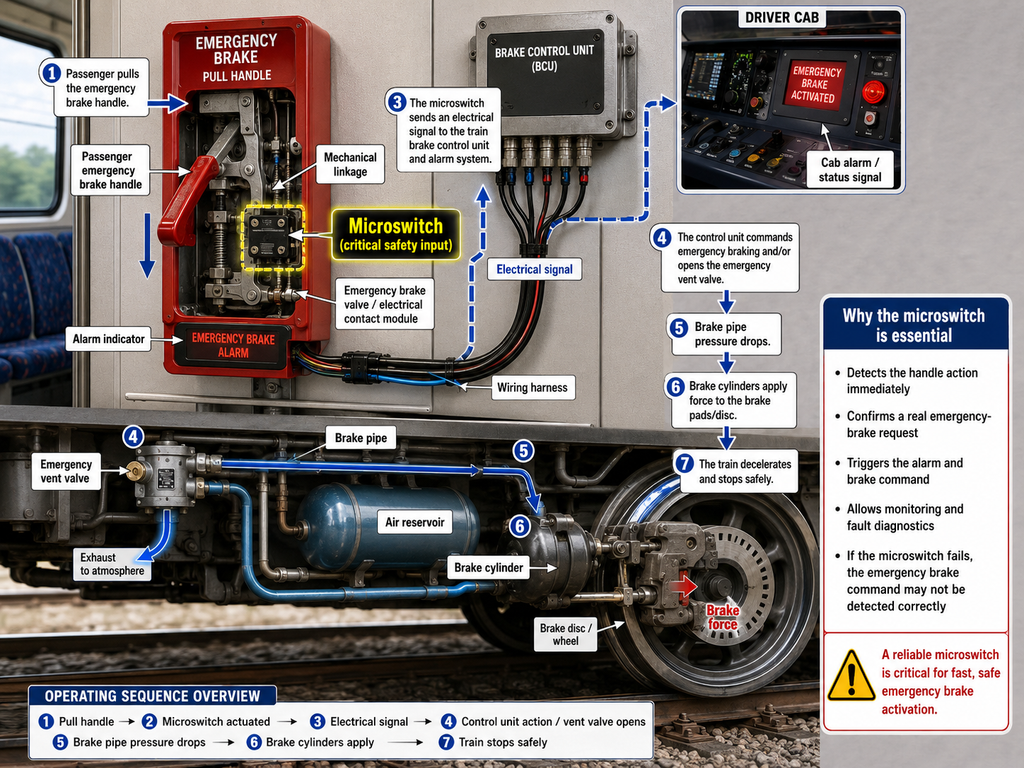
The system must then be able to manage different operating situations. It may alert the driver to a potential hazard, allow the train to continue temporarily so that it can be stopped at a safer location, or lead to an automatic stop under the conditions defined by the PAS architecture.
In this context, a passenger alarm system railway application cannot be regarded as a simple control circuit. It is a complete safety-related function involving interactions between the passenger device, wiring, interfaces, onboard logic, the driver, and the braking system.
And every one of those interactions depends on the quality of the information received at the beginning of the chain.
Why a Simple Electrical Contact Becomes Safety-Critical
A microswitch performs what appears to be a very simple task: it detects a mechanical movement and changes the state of one or more electrical contacts.
In a conventional application, a contact failure may cause a relatively limited functional issue. In a chain associated with a passenger alarm or an emergency braking request, the potential consequences are very different.
The component must be capable of producing an unambiguous change of state when the mechanism is activated.
The engineering question is therefore not simply:
Does the contact switch?
A more relevant question is:
Can the contact be relied upon to reach the required state when the safety function is actually demanded?
That distinction is fundamental.
An electromechanical contact operates in a real-world environment. Over time, its contact surfaces may be exposed to wear, electrical arcing, or repeated mechanical stress. The mechanism itself may be subjected to vibration, shocks, dust, humidity, or temperature variations.
A safety architecture therefore cannot rely solely on the nominal behavior of the component. It must also take into account how the component behaves under fault conditions.
This is where the principle of the positive break switch becomes particularly important.
Positive Break: Ensuring Controlled Mechanical Opening
In a conventional snap-action microswitch, an internal mechanism ensures rapid contact switching. This technology provides excellent repeatability and prevents the actuator speed from directly resulting in slow electrical switching.
For some safety-related functions, however, an additional requirement arises: the ability to mechanically guarantee the opening of a normally closed contact once the actuator reaches a defined position.
This is the principle of positive opening, also known as positive break.
In such a mechanism, separation of the safety contact does not depend solely on spring energy or on the conventional snap-action mechanism. A mechanical linkage forces the contact to open once the required actuator travel has been reached.
This characteristic becomes particularly relevant when a fault must result in a detectable state, or when opening a circuit is part of the overall safety strategy.
An emergency brake microswitch featuring positive-opening operation therefore adds an additional level of robustness to mechanical detection.
This does not mean that a microswitch alone can make a system compliant with a railway safety standard. Compliance applies to the complete architecture, its interfaces, and the overall behavior of the system.
However, choosing the right component can make it easier to design a chain in which the behavior under demand must remain deterministic.
The Real Issue: Controlling Failure Modes
For an engineer working on a safety-related function, nominal performance is never the only concern. Failure modes are what determine whether an architecture is truly robust.
Consider a contact used to detect activation of an emergency device.
Under normal conditions, its change of state may be perfectly repeatable. But several scenarios must be considered over the product lifecycle: contact welding or sticking, mechanical drift, contamination, loss of actuator travel, connection failure, or general ageing of the mechanism.
The value of a railway safety switch designed around positive opening lies precisely in reducing dependence on certain internal contact behaviors when opening is required.
From an engineering perspective, this makes functional analysis clearer. Instead of simply expecting an electrical transition to occur, the design establishes a mechanical relationship between the position of the actuator and the effective opening of the relevant circuit.
That distinction is particularly important in systems where diagnostics, state monitoring, or fail-safe logic form part of the overall architecture.
Reliability Goes Beyond the Electrical Principle
Selecting the appropriate contact technology is not enough.
A railway emergency brake switch operates in an especially demanding environment. Mechanical and environmental constraints are part of the design problem just as much as the electrical schematic.
Vibration is an obvious example. Onboard railway equipment may be subjected to repeated mechanical stress for years. The challenge is to avoid unintended switching while maintaining stable operating characteristics throughout the service life of the component.
Shock resistance must also be considered, particularly for devices handled by passengers or installed in assemblies exposed to operational and maintenance stresses.
Environmental conditions add another layer of complexity: dust, humidity, possible condensation, and temperature variations depending on the installation location.
Mechanical lifetime is equally important. Railway safety is considered over long operating periods. A component may rarely be functionally activated while remaining permanently exposed to its environment. Conversely, testing and maintenance procedures may introduce additional switching cycles.
Microswitch selection must therefore take into account its mechanism, protection level, connection method, environmental resistance, and mechanical integration at the same time.
Mechanical Travel Matters as Much as Contact Design
One aspect is sometimes underestimated: a safety microswitch can only perform correctly if it is actuated correctly.
Component selection therefore cannot be separated from the design of the surrounding mechanism.
The available actuator travel must be sufficient to reach the position required for positive opening. Mechanical tolerances, wear of surrounding parts, and assembly variations must also be included in the analysis.
Engineers need to verify, in particular, that after several years of operation, the remaining mechanical movement will still be sufficient to produce the expected electrical state.
This design margin is fundamental.
A component may offer excellent electrical characteristics and still become the weak point of the system if it is used too close to the limit of its functional travel. Conversely, a properly dimensioned mechanical integration contributes directly to the robustness of the safety function.
The microswitch should therefore be seen as the interface between two worlds: the mechanics of the emergency device and the electrical logic of the train.
EN 16334-1: Thinking at System Level
EN 16334-1 should not be interpreted as a simple list of requirements applying to a switch. Its scope is the Passenger Alarm System as a whole.
It addresses areas including PAS architecture and interfaces, expected functions, event sequences, degraded modes, and minimum safety requirements.
For engineers, this system-level approach means that every component must be considered in relation to the function it performs.
A microswitch can be extremely reliable and still be poorly integrated into an architecture. Conversely, sophisticated electronic logic cannot completely compensate for mechanical information that was never detected correctly in the first place.
A robust passenger alarm system railway architecture therefore relies on a coherent chain: mechanical actuation, detection, signal transmission, processing, diagnostics, and system response.
Within that chain, the switch may be physically small, but its functional importance can be significant.
PBX-R / PBX: Technology Designed for Demanding Switching Functions
This is the context in which PBX-R / PBX microswitches from Crouzet are relevant.
The PBX range is based on a snap-action mechanism combined with positive opening, using electrically separated changeover contacts in an SPDT Form Zb configuration. Depending on the reference, different protection levels, actuator configurations, and connection options are available. PBX and PBX-R variants can also be specified with protection ratings up to IP67.
Crouzet positions the PBX family for several critical railway applications, including braking systems, door locking mechanisms, onboard circuit breakers, and switch-point position detection, with positive opening playing a central role in reliable switching.
For a railway emergency brake switch, the value of PBX-R / PBX therefore lies not simply in its ability to open or close an electrical circuit. It lies in the controlled mechanical behavior of the contact, its design for demanding operating environments, and its ability to integrate into a safety chain where electrical information must remain dependable when passenger safety is at stake.
In a modern railway system, the most critical functions are not always performed by the most complex components. Sometimes, an entire safety architecture begins with only a few millimeters of mechanical movement—and with a microswitch that must, on that day just as reliably as years after entering service, switch exactly as intended.